0%
MADRASAS IN SOUTH ASIA
Index
Search
MADRASAS IN SOUTH ASIA
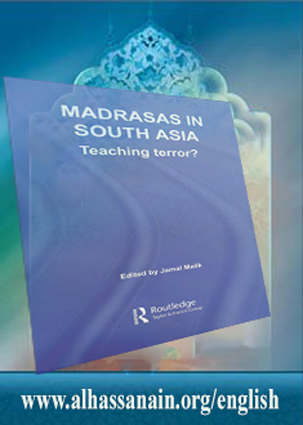
Publisher: Routledge
Category: visits: 28783
Download: 7813


- CONTRIBUTORS
- ACKNOWLEDGEMENTS
- 1: INTRODUCTION
- The problematique
- The historical context
- The political economy of madrasas
- The ideational resistance
- The arrangement of contributions
- Notes
- 2: AHL-I SUNNAT MADRASAS
- The Madrasa Manzar-i Islam, Bareilly, and Jamia Ashrafiyya, Mubarakpur
- The Dars-i Nizami and other intellectual issues
- Madrasa Manzar-i Islam
- The Madrasa today
- The Jamia Ashrafiyya, Mubarakpur
- Early years
- Consolidation and growth: 1934–72
- Maulana Abd al-Aziz, founder of the Dar al-Ulum Ashrafiyya
- Jamia Ashrafiyya, 1990s to the present
- Maulana Yasin Akhtar Misbahi
- Conclusion
- Appendix
- Table 2.1 Books taught at the Madrasa Manzar-i Islam
- First year
- Second year
- Third year
- Fourth year
- Fifth year
- Sixth year
- Seventh year
- Eighth year
- Table 2.2 Books taught at the Jamia Ashrafiyya, Mubarakpur
- 3: MAKING MUSLIMS
- Identity and difference in Indian madrasas
- Dastur-i Amal
- The dars
- The non-dars
- The performance
- Concluding remark
- Notes
- 4: MADRASAS
- The potential for violence in Pakistan?
- Review of literature
- Type and number of madrasas
- Table 4.1 Central boards of madrasas in Pakistan
- Table 4.2 Sect-wise increase in the number of madrasas
- Table 4.3 Increase in the madrasas between 1988 and 2000
- The sectarian divide among the madrasa
- The curriculum of the madrasas
- The refutation of other sects and sub-sects
- The refutation of heretical beliefs
- The refutation of alien philosophies
- Poverty and socio-economic class of madrasa students
- Table 4.4 Causes of joining madrasas given by students
- Poverty and the roots of religious violence
- The world-view of madrasa students
- Madrasas and militancy
- What made the madrasas militant?
- Militancy and Islamist fighters
- Can Islamic militancy be reduced?
- Conclusion
- Appendix 4.1
- Survey 2003
- Survey of schools and madrasas
- Table 4.5 Consolidated data of opinions indicating militancy and tolerance among three types of school students in Pakistan in survey 2003 (%)
- Appendi 4.2 and 4.3
- Table 4.6 Number of Dini Madrasas by enrolment and teaching staff
- Appendix 4.3
- Table 4.7 Dini Madrasas by type of affiliation and area
- Note
- 5: PAKISTANI MADRASAS AND RURAL UNDERDEVELOPMENT
- An empirical study of Ahmedpur East
- Introduction
- Definition
- Case analysis
- Ahmedpur case analysis
- Figure 5.1 Study area location map
- Table 5.1 Number of students by sect in madrasas, 2004
- State of public education and madrasas
- Figure 5.2 Increase in number of madrasas in APE 1994–2004
- Table 5.2 Residential versus non-residential madrasas in Ahmedpur
- Table 5.3 Registration status of madrasas
- Table 5.4 Comparison of government schools and madrasa enrolment in Ahmedpur
- Table 5.5 Madrasas involved in sectarianism
- Table 5.6 Location of trouble spots
- Environmental and developmental differentiation of sectors
- Table 5.7 Electrification in key study area locations
- Conclusions and recommendations
- Notes
- 6: PAKISTAN’S RECENT EXPERIENCE IN REFORMING ISLAMIC EDUCATION
- Estimating madrasa enrolment
- Islamic boarding schools in Pakistani society
- The recent madaris ordinances
- Impact of ordinances on Islamic educational reforms
- Registration of existing madaris
- Establishment of new Model Dini Madaris
- Islamic education in private and government schools
- Madaris in the context of general education
- Recommendations
- Note
- 7: THE GENDER OF MADRASA TEACHING
- I: Zeenat at school and at home
- II: the case of Shahzad
- III: the progressive madrasa
- Conclusions
- Note
- 8: MADRASA AND MUSLIM IDENTITY ON SCREEN
- Nation, Islam and Bangladeshi art cinema on the global stage
- Construction of identities and Bengali–Muslim dichotomy in Bangladesh
- Islam and Bangladeshi art cinema: Bengali/Muslim conflict on screen
- Madrasa, Masud and The Clay Bird: Bangladeshi art cinema towards heterogenizing Islam
- Conclusion
- 9: POWER, PURITY AND THE VANGUARD
- Educational ideology of the Jama’at-i Islami of India
- The argument
- Loss of power, power of loss
- Context and biography
- Purity and power
- Education for power
- Sources of knowledge and historical lag
- Mimic the West
- New alternative
- College as ‘slaughterhouse’
- Features of the alternative
- Situating the alternative
- New ship, new captain
- Educational spectrum
- Table 9.1 Maududi’s position towards sect/ideology-based educational institutions
- Notes
- State, Islam and education
- Conclusion
- Notes
- 10: IN LIEU OF A CONCLUSION
- BIBLIOGRAPHY
MADRASAS IN SOUTH ASIA
Author: Jamal MalikPublisher: Routledge
English